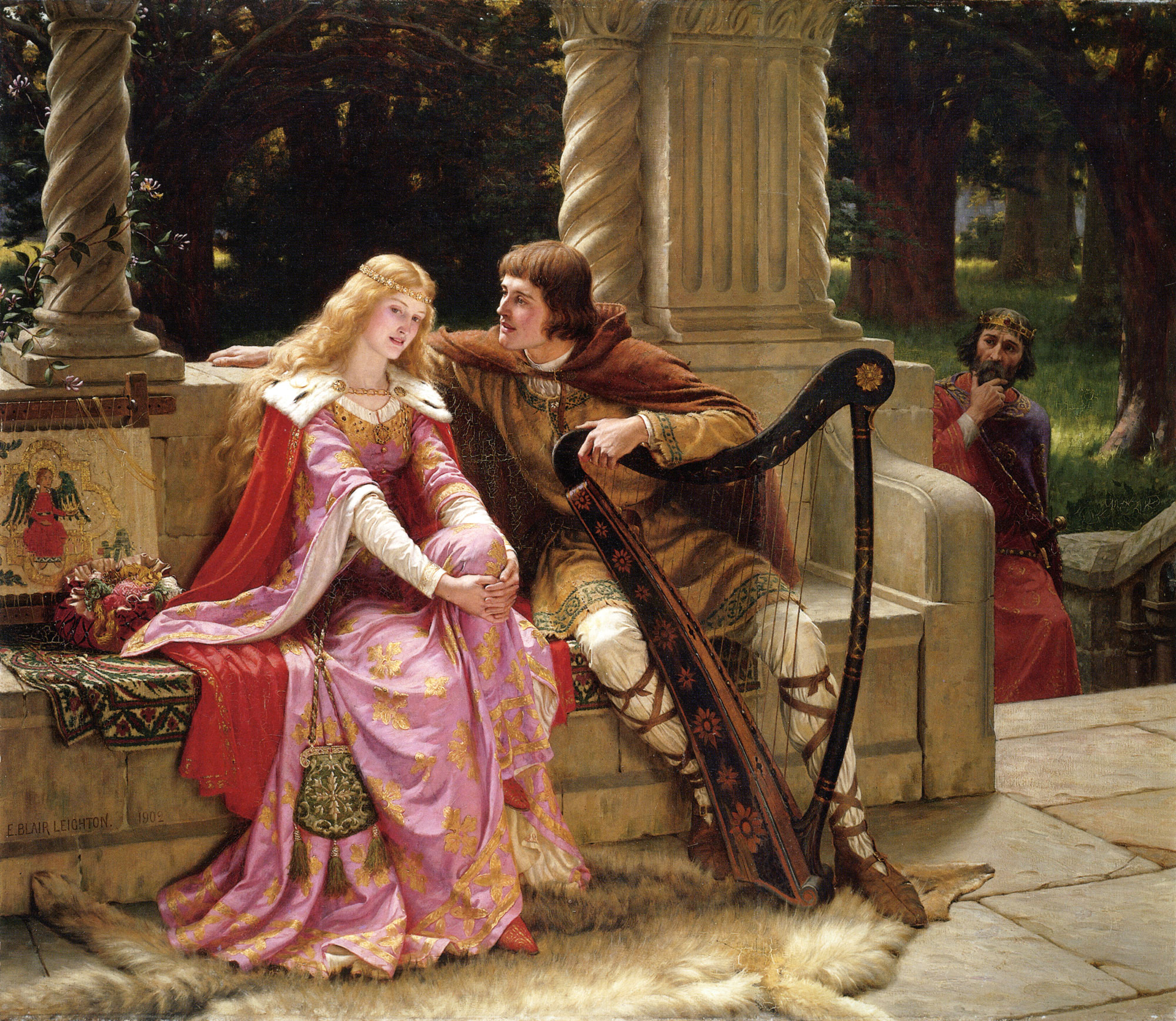
In the Dark Ages, after the fall of the Roman Empire, weak Britain is divided into several clans, while the powerful Ireland, untouched by the Romans, dominates and ravages the British tribes. The just and noble British leader, Marke, meets with the other clan chiefs to try to unite the country, but they are attacked and slaughtered by the Irish army headed by Morholt. Marke loses one hand protecting the young Tristan, who had just lost his parents, and Marke raises the boy as if he were of his blood.
Years later, after another attack by the Irish forces, Tristan rescues his people, who had been captured to serve as slaves, and kills the brutal Morholt, to whom the beautiful Irish princess, Isolde, had been promised in marriage. Tristan is poisoned by the sword of Morholt, declared dead by his mates, and put on a boat as part of his funeral. The ship floats out to sea, and lands on the Irish shore.
Isolde, along with her maid-servant, Bradnae, finds the boat with Tristan in it, and hides him in a hut, where she nurses him back to health. In the process, they fall in love for each other, but with Isolde concealing her identity from Tristan.
When Tristan is about to be discovered by Irish guards, he escapes by boat back to Britain to avoid being captured and killed. Isolde's father, King Donnchadh, together with the British traitor Wictred, declares a joust as part of a plan to divide the British and make Wictred king, by promising the hand of Isolde to the winner. However, Tristan wins the tournament. Without knowing that Isolde is his love, Tristan offers her to Marke, in order to make Marke king and thus unify the British clans. When Tristan sees who Isolde is, he must decide between his friendship and loyalty to Marke and his love for Isolde.
Showing posts with label Screenplay: A. Inspiration. Show all posts
Monday, 6 February 2012
Tristan and Isolde (2006)
The Story of Tristan and Iseult
The legend of Tristan and Iseult is an influential romance and tragedy, retold in numerous sources with as many variations. The tragic story is of the adulterous love between the Cornish knight Tristan (Tristram) and the Irish princess Iseult (Isolde, Yseult, etc.). The narrative predates and most likely influenced the Arthurian romance of Lancelot and Guinevere, and has had a substantial impact on Western art, the idea of romantic love and literature since it first appeared in the 12th century. While the details of the story differ from one author to another, the overall plot structure remains much the same.
Legend
There are two main traditions of the Tristan legend. The early tradition comprised the French romances of two poets from the second half of the twelfth century, Thomas of Britain and Béroul. Their sources could be traced back to the original, archetypal Celtic romance. Later traditions come from the Prose Tristan (c. 1240), which was markedly different from the earlier tales written by Thomas and Béroul. The Prose Tristan became the common medieval tale of Tristan and Iseult that would provide the background for the writings of Sir Thomas Malory, the English author, who wrote Le Morte d'Arthur (c. 1469).
The story and character of Tristan vary from poet to poet. Even the spelling of his name varies a great deal, although "Tristan" is the most popular spelling. Most versions of the Tristan story follow the same general outline.
After defeating the Irish knight Morholt, Tristan goes to Ireland to bring back the fair Iseult for his uncle King Mark to marry. Along the way, they ingest a love potion which causes the pair to fall madly in love. In the courtly version, the potion's effects last for a lifetime; in the common versions, the potion's effects wane after three years. In some versions, they ingest the potion accidentally; in others, the potion's maker instructs Iseult to share it with Mark, but she deliberately gives it to Tristan instead. Although Iseult marries Mark, she and Tristan are forced by the potion to seek one another as lovers. Although the typical noble Arthurian character would be shamed from such an act, the love potion that controls them frees Tristan and Iseult from responsibility. The king's advisors repeatedly try to have the pair tried for adultery, but again and again the couple use trickery to preserve their façade of innocence. In Béroul's version, the love potion eventually wears off, and the two lovers are free to make their own choice as to whether they cease their adulterous lifestyle or continue.
As with the Arthur-Lancelot-Guinevere love triangle, Tristan, King Mark, and Iseult all hold love for each other. Tristan honors, respects, and loves King Mark as his mentor and adopted father; Iseult is grateful that Mark is kind to her; and Mark loves Tristan as his son, and Iseult as a wife. But every night, they each have horrible dreams about the future. Tristan's uncle eventually learns of the affair and seeks to entrap his nephew and his bride. Also present is the endangerment of a fragile kingdom, the cessation of war between Ireland and Cornwall. Mark gets what seems proof of their guilt and resolves to punish them: Tristan by hanging and Iseult by burning on the stake, later putting her up in a lazar house (a leper colony). Tristan escapes on his way to the gallows by a miraculous leap from a chapel and rescues Iseult. The lovers escape into the forest of Morrois and take shelter there until they are discovered by Mark. They make peace with Mark after Tristan's agreement to return Iseult to Mark and leave the country. Tristan then travels on to Brittany, where he marries (for her name and her beauty) Iseult of the White Hands, daughter of Hoel of Brittany and sister of Sir Kahedin.
In the Prose Tristan and works derived from it, Tristan is mortally wounded by Mark, who treacherously strikes Tristan with a poisoned lance while the latter is playing a harp for Iseult. The poetic versions of the Tristan legend offer a very different account of the hero's death. According to Thomas' version, Tristan was wounded by a poison lance while attempting to rescue a young woman from six knights. Tristan sends his friend Kahedin to find Iseult, the only person who can heal him. Tristan tells Kahedin to sail back with white sails if he is bringing Iseult, and black sails if he is not. Iseult agrees to return to Tristan with Kahedin, but Tristan's jealous wife, Iseult of the White Hands, lies to Tristan about the colour of the sails. Tristan dies of grief, thinking that Iseult has betrayed him, and Iseult dies swooning over his corpse. Several versions of the Prose Tristan include the traditional account of Tristan's death found in the poetic versions. In some sources it states that two trees (hazel and honeysuckle) grow out of their graves and intertwine their branches so that they cannot be parted by any means. It was said that King Mark tried to have the branches cut three separate times, and each time, the branches grew back and intertwined, so therefore he gave up and let them grow.
A few later stories record that the lovers had a number of children. In some stories they produced a son and a daughter they named after themselves; these children survived their parents and had adventures of their own. In the romance Ysaie the Sad, the eponymous hero is the son of Tristan and Iseult; he becomes involved with the fay-king Oberon and marries a girl named Martha, who bears him a son named Mark.
Legend
There are two main traditions of the Tristan legend. The early tradition comprised the French romances of two poets from the second half of the twelfth century, Thomas of Britain and Béroul. Their sources could be traced back to the original, archetypal Celtic romance. Later traditions come from the Prose Tristan (c. 1240), which was markedly different from the earlier tales written by Thomas and Béroul. The Prose Tristan became the common medieval tale of Tristan and Iseult that would provide the background for the writings of Sir Thomas Malory, the English author, who wrote Le Morte d'Arthur (c. 1469).
The story and character of Tristan vary from poet to poet. Even the spelling of his name varies a great deal, although "Tristan" is the most popular spelling. Most versions of the Tristan story follow the same general outline.
After defeating the Irish knight Morholt, Tristan goes to Ireland to bring back the fair Iseult for his uncle King Mark to marry. Along the way, they ingest a love potion which causes the pair to fall madly in love. In the courtly version, the potion's effects last for a lifetime; in the common versions, the potion's effects wane after three years. In some versions, they ingest the potion accidentally; in others, the potion's maker instructs Iseult to share it with Mark, but she deliberately gives it to Tristan instead. Although Iseult marries Mark, she and Tristan are forced by the potion to seek one another as lovers. Although the typical noble Arthurian character would be shamed from such an act, the love potion that controls them frees Tristan and Iseult from responsibility. The king's advisors repeatedly try to have the pair tried for adultery, but again and again the couple use trickery to preserve their façade of innocence. In Béroul's version, the love potion eventually wears off, and the two lovers are free to make their own choice as to whether they cease their adulterous lifestyle or continue.
In the Prose Tristan and works derived from it, Tristan is mortally wounded by Mark, who treacherously strikes Tristan with a poisoned lance while the latter is playing a harp for Iseult. The poetic versions of the Tristan legend offer a very different account of the hero's death. According to Thomas' version, Tristan was wounded by a poison lance while attempting to rescue a young woman from six knights. Tristan sends his friend Kahedin to find Iseult, the only person who can heal him. Tristan tells Kahedin to sail back with white sails if he is bringing Iseult, and black sails if he is not. Iseult agrees to return to Tristan with Kahedin, but Tristan's jealous wife, Iseult of the White Hands, lies to Tristan about the colour of the sails. Tristan dies of grief, thinking that Iseult has betrayed him, and Iseult dies swooning over his corpse. Several versions of the Prose Tristan include the traditional account of Tristan's death found in the poetic versions. In some sources it states that two trees (hazel and honeysuckle) grow out of their graves and intertwine their branches so that they cannot be parted by any means. It was said that King Mark tried to have the branches cut three separate times, and each time, the branches grew back and intertwined, so therefore he gave up and let them grow.
A few later stories record that the lovers had a number of children. In some stories they produced a son and a daughter they named after themselves; these children survived their parents and had adventures of their own. In the romance Ysaie the Sad, the eponymous hero is the son of Tristan and Iseult; he becomes involved with the fay-king Oberon and marries a girl named Martha, who bears him a son named Mark.
Thursday, 2 February 2012
Media Inspiration - The Shadow of the Tower
The Shadow of the Tower (1972)
Historical dramas are all the rage on TV these days, from Showtime’s The Tudors and upcoming The Borgias to Starz’s Spartacus. Forty years ago, BBC already was forging the genre with their acclaimed series about the history of British royalty. First came The Six Wives of Henry VIII in 1970, chronicling the same time period The Tudors later would cover, and focusing on a different wife of Henry in each of its six episodes. Elizabeth R followed in 1971 with a recounting of the rise and reign of Henry VIII’s daughter, Elizabeth I. The Shadow of the Tower aired in 1972 as the third series, a prequel to the first. More than twice as long as each of the first two series, The Shadow of the Tower tells the story of Henry VII in its thirteen episodes, detailing a less frequently dramatized era of the Tudor dynasty.James Maxwell stars as Henry Tudor, and the series opens with his rise to the throne upon defeating Richard III in battle at the conclusion of the War of the Roses. Henry VII was the final British king to secure the throne through combat, and one of the struggles shown throughout The Shadow of the Tower is his attempt to hold onto the seat and power he won. We also see Henry’s courtship of and eventual marriage to Elizabeth of York, played by Norma West. Their children will be familiar to nearly anyone who has heard of the Tudors as the series depicts the birth and early life of Henry VIII and his siblings. Behind all the family drama and history is a rich history of royal politics and post-war power struggles.
The story of Henry VII usually takes a backseat to that of his more notorious and flamboyant heir, so a lot of The Shadow of the Tower may be new even to those previously interested in the Tudors. The series characterizes Henry VII in a balanced manner, showing him at his best and at his worst, and delivering some believable period settings that probably feel even more authentic thanks to the age of the production itself.
TUDORS IN THE MOVIES AND TV SERIES
Anne of the Thousand Days (1969)
Henry VIII of England discards one wife, Katharine of Aragon, who has failed to produce a male heir, in favor of the young and beautiful Anne Boleyn.
Elizabeth (1998)
A film of the early years of the reign of Elizabeth I of England and her difficult task of learning what is necessary to be a monarch.
In the Shadow of the Tower (1972)
A series of dramas by various writers recording the key events in the reign of Henry Tudor and his founding of the Tudor Dynasty
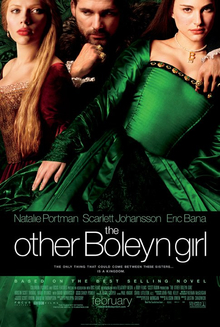
The Other Boleyn Girl (2008)
A sumptuous and sensual tale of intrigue, romance and betrayal set against the backdrop of a defining moment in European history: two beautiful sisters, Anne and Mary Boleyn, driven by their family's blind ambition, compete for the love of the handsome and passionate King Henry VIII.
The Tudors (2007-2010)
A dramatic series about the reign and marriages of King Henry VIII.
Tuesday, 31 January 2012
Media Inspiration - The Tudors
I am a big fan of the series THE TUDORS.
This costume drama features England's splendid Renaissance dynasty under King Henry VIII. Beginning in Season 1 when Henry VIII was growing desperate for an heir and growing distant from his first wife, the series moves quickly to the period when Anne Boelyn became his obsession. During this time Cardinal Wolsey rose to become the power behind his throne, ruling ruthlessly and nearly absolutely while Henry (played by Johnathon Rhyes Meyers) for the most part followed the Cardinal's advice, maneuvering through a series of betrayals and plots against him. When Anne Boelyn plays much harder to get than any woman ever has, Henry begins to search for a way out of his marriage to Katherine of Aragon, so that he can make Anne his wife. Needing a divorce, Henry turns to Wolsey, who promises to help him create waves of backlash from the church, as well as the Spanish Habsburg dynasty and its overseas empire..
Here are the trailers to all 4 seasons:
Here are some scenes that I inspired to during wriring my screenplay:
Most of the screenplay inspired from THE TUDORS is from the finale episode, DEATH OF A MONARCHY.
Tuesday, 17 January 2012
Media Inspiration - Camelot
Guinevere – an ambitious and strong willed woman, making her a source of great support and strength to Arthur as he grows into his role as king. Although she is married to Leontes, one of Arthur's most loyal knights, she cannot deny the attraction she and Arthur feel for each other.
Igraine – Arthur's biological mother and second wife of King Uther. She is estranged from her son and despised by her step-daughter Morgan. She has lived a life of deep pain and agony, but has never lost her faith or her heart. Igraine quickly becomes an ally and figure of strength for Arthur and the entire court of Camelot.

| By Luke Bonanno "Camelot" seems to have been Starz's attempt to do for Arthurian legend what its "Spartacus" series have done for ancient Roman gladiators, to tell the true story with violence and language beyond what network and basic cable could allow. If you're wondering whether they were able to repeat the success of "Spartacus", know that though branded The Complete First Season, this week's DVD and Blu-ray releases of "Camelot" in fact represent the complete series. There is no denying the impact and appeal of the source lore. So much of King Arthur's story has seeped into the cultural conscience that even almost a thousand years removed from the legend's popularization, the names Merlin, Guinevere, and Lancelot and phrases like Excalibur and the Knights of the Round Table are used without explanation or any need for it. The believed fictional British king of the 5th and 6th centuries A.D. warrants little in the way of synopsis. But whether you've gleaned your information from family films, Lerner and Loewe, Geoffrey of Monmouth, Jerry Bruckheimer, or Monty Python, "Camelot" is sure not to simply retell the story as you remember it. After all, could you fill ten 50-minute episodes with what you know about the subject? Besides, it's not like one definitive version of the tale exists. Unfortunately, "Camelot" is lacking. Though its story would seem to rank as one of the most compelling ever told, the way we get it in soapy, serialized episodes drains it of power and the execution leaves much to be desired. Acting, dialogue, and characterization all fail to do this dramatic, fantastic royal adventure any justice. No one aspect is glaringly problematic, but neither are any of them competent enough to satisfy. Any joy the series provides emerges mainly from reacquainting yourself with the legend and seeing how elements of it are interpreted. The more familiar you are with the lore, the more likely you are to be disappointed. Of chief interest to "Camelot" in its first and only season is the succession of power. The show opens with the fatal poisoning of King Uther by his banished daughter Morgan Pendragon (Casino Royale Bond girl Eva Green). Bad girl Morgan expects to inherit the throne, but instead the bald, ageless sorcerer Merlin (Shakespeare in Love's Joseph Fiennes) tracks down the illegitimate son of Uther and Queen Igraine (Claire Forlani, back in action), a young man who has been living as a peasant. Merlin's claim that stringy-haired, lightly goateed Arthur Pendragon (Sweeney Todd's Jamie Campbell Bower) is the true heir to the throne is contested by Morgan, resulting in stern words, sword-clanging, and the murder of a foster mother. Speaking of Merlin, one thing that especially does not work about "Camelot" is Joseph Fiennes. I long thought it curious that Fiennes could hold the title role in a Best Picture Oscar winner and then essentially disappear while his older brother Ralph remained respected and in demand. Then I finally saw Joseph in something else, playing the lead role in ABC's initially promising, soon disappointing single season casualty "FlashForward." He was a weak spot there, unable to draw sympathy in the easiest of opportunities. With top billing going to Fiennes, that sets the bar pretty low and none of his cast mates is determined to raise it. They are commonly hindered by the material and the standard historical drama tone and speech patterns, but must accept some blame for the frequent nonsensicality. A touch of intrigue still emerges in spite of the failings, but they are a lot to overlook in order to reach enjoyment. Though much less raunchy and gory than the two "Spartacus" series, Starz's "Camelot" still takes a graphic approach to its material that will inspire some blushing. The lurid approach makes sense for barbaric ancient Rome and those shows at least have strong storylines and well-utilized casts to fall back on. As is, there's not much to take from this. Those who always welcome a new interpretation of King Arthur folklore will want to check "Camelot" out, but I doubt they'll be really pleased by it. Everyone else not sold on scattered swordplay and sex can take a pass. Anchor Bay's DVD is adequate. Though it might partially be me getting used to Blu-ray, the feature presentation feel a little lacking. The extras are no doubt more lightweight than fans would like. In short, disappointment surrounds "Camelot." |
Friday, 13 January 2012
The Lady of the Rivers is #1 New York Times bestselling author Philippa Gregory’s remarkable story of Jacquetta, Duchess of Bedford, a woman who navigated a treacherous path through the battle lines in the Wars of the Roses.
Descended from Melusina, the river goddess, Jacquetta always has had the gift of second sight. As a child visiting her uncle, she met his prisoner, Joan of Arc, and saw her own power reflected in the young woman accused of witchcraft. They share the mystery of the tarot card of the wheel of fortune before Joan is taken to a horrific death at the hands of the English rulers of France. Jacquetta understands the danger for a woman who dares to dream.
Jacquetta is married to the Duke of Bedford, English regent of France, and he introduces her to a mysterious world of learning and alchemy. Her only friend in the great household is the duke’s squire Richard Woodville, who is at her side when the duke’s death leaves her a wealthy young widow. The two become lovers and marry in secret, returning to England to serve at the court of the young King Henry VI, where Jacquetta becomes a close and loyal friend to his new queen.
The Woodvilles soon achieve a place at the very heart of the Lancaster court, though Jacquetta can sense the growing threat from the people of England and the danger of royal rivals. Not even their courage and loyalty can keep the House of Lancaster on the throne. Henry the king slides into a mysterious sleep; Margaret the queen turns to untrustworthy favorites for help; and Richard, Duke of York, threatens to overturn the whole kingdom for his rival dynasty.
Jacquetta fights for her king, her queen, and for her daughter Elizabeth for whom Jacquetta can sense an extraordinary and unexpected future: a change of fortune, the throne of England, and the white rose of York.
A sweeping, powerful story rich in passion and legend and drawing on years of research, The Lady of the Rivers tells the story of the real-life mother of the white queen.
Review:
Philippa Gregory, the well-known Queen of historical fiction, returns with another wonderful journey into the fascinating, though at time treacherous, times of the Cousins' War. This time, Gregory takes on the fairly-unknown Jacquetta, the long-time friend of Lancaster queen Margaret of Anjou and mother of Elizabeth Woodville, the wife of York king Edward, and main subject of "The White Queen."According to interviews and other conversations with Gregory I've read, her initial inspiration for the novel came during her research on Elizabeth Woodville, thus she decided to hold off on the previously planned third book, The White Princess, and make a small detour with Jacquetta's story. However, when Gregory went to research more thoroughly into Jacquetta's life, she found that virtually no research had been done, and that the only way for her to find the information she needed, was to conduct her own research into original source documents, which not only led to the creation of The Lady of the Rivers, but also to the creation of The Women of the Cousins' War, a non-fiction exploration of the three ladies Gregory has written on so far in the series.
Jacquetta is quite possibly the most fascinating woman Gregory has explored thus far. Born into a well-to-do family in Luxembourg, Jacquetta grew up knowing that she was descended from the water goddess Melusina and related to much of European nobility. Married off to the Duke of Bedford, the English regent of France, Jacquetta finds a scholarly intellectual of a husband, though the two share no bonds of love. After her husband's death, Jacquetta dares to fall in love with a lowly squire, Richard Wooville, and the pair marry in secret. Once the couple returns to England, Jacquetta carves out a place for herself at the court of Henry VI, and becomes a close friend to Queen of Anjou.
After The White Queen, I was somewhat tired of the constant discussion of Melusina and medieval witchcraft, and was honestly not too excited to see that Gregory chose to have this same discussion again in Lady of the Rivers. Thankfully, it was not as large of a piece of the book as in White Queen, but I was still a little tired of it. Despite this, reading about Jacquetta's life felt like I was opening up a door to an unknown and unexplored life of passion, triumph, love and politics. I was particularly intrigued by the opening (though it likely never happened), when, as a young woman, Jacquetta meets Joan of Arc while visiting her uncle. Spending time with Joan had a profound impact on Jacquetta, introduced her to the horrible realities of life, and somewhat foreshadows Jacquetta's own destiny.
Though it was a little sad to see Jacquetta becoming such close friends with the Lancasters, while knowing from The White Queen how she completely and somewhat shamelessly switches side later, Gregory weaves together another fascinating tale with her lovely, signature prose that's sure to please historical fiction fans.
Inspiration: The White Queen
The first in a stunning new series, The Cousins’ War, is set amid the tumult and intrigue of the Wars of the Roses. Internationally bestselling author Philippa Gregory brings this extraordinary family drama to vivid life through its women – beginning with Elizabeth Woodville, the White Queen.
Elizabeth Woodville, of the House of Lancaster, is widowed when her husband is killed in battle. Aided and abetted by the raw ambition and witchcraft skills of her mother Jacquetta, Elizabeth seduces and marries, in secret, reigning king Edward IV, of the family of the white rose, the House of York. As long as there are other claimants to Edward’s throne, the profound rivalries between the two families will never be laid to rest. Violent conflict, shocking betrayal and murder dominate Elizabeth’s life as Queen of England, passionate wife of Edward and devoted mother of their children.
“Your house's emblem should not be the white rose but the old sign of eternity [...] the snake which eats itself. The sons of York will destroy each other, one brother destroying another, uncles devouring nephews, fathers beheading sons. They are a house which has to have blood and they will shed their own if they have no other enemy.” Not for Edward and Elizabeth is there a carriage ride watched by billions, months of hype, houses draped in flags and bunting and a Knit Your Own Royal Wedding book published especially for the occasion. Edward and Elizabeth's marriage takes place in haste and in secrecy before the latest battle in the War of the Roses, before a handful of witnesses. After the event, Elizabeth's brother casts doubt on the validity of the marriage, witnessed by three women and a young boy, and warns her that it would be easy for the King to claim that he had never been legally married and prove it all to be a ploy to get Elizabeth into his bed.
Ms Gregory demonstrates this marriage to be a whole-family affair. There is not just a new queen, but her whole family becomes embroiled in politics at a very turbulent time. Philippa Gregory shows a different side to the story from that of the history books, focusing on the role of the women behind the scenes. From the moment of her marriage, Elizabeth has to keep her wits about her at all times, as she gets mixed up in a world of scheming and treachery, obsessive ambition and murder, in a seemingly endless cycle of revenge. Elizabeth describes how her rival, Margaret of Anjou, "will not accept her defeat, she will plot and scheme for her son, just as Edward told me, that I must plot and scheme for ours. She will never stop until she is back in England and the battle is drawn up again. She will never stop until her husband is dead, her son is dead, and she has no one left to put on the throne. This is what it means to be Queen of England in this country today." But once Margaret of Anjou has ceased to be a threat, new claimants for the throne rise. As described in the quote at the top of the page, when there are no threats to Edward's rule from outside his house, his own brothers turn against him and each other, and with each betrayal, Elizabeth vows vengeance. The book paints a bitter picture of how unforgiveness destroys and is never satisfied.
The White Queen is set earlier than Gregory's usual era (The Tudors) and I confess I have little memory of my history lessons before the resolution of the war covered in this novel - see the first episode of Blackadder to see how that might or might not have turned out. I also found it a little confusing for the sheer number of people named Edward and Richard, and the different names and titles of other characters. But once I got my head around who was who, I was fascinated by the twists and turns, the to-and--fro of the houses' fortunes, culminating in the disappearance of Elizabeth's sons to King Edward, well-known as "the Princes in the Tower." Being a historical novel based upon real people, it is difficult to work out how much of the story is true and how much is speculation, although Gregory's note at the back explains some of her decisions for the direction of the plot. With conflicting theories and sources available to her, Gregory had to choose her own theories about the most likely truth, although she does not provide any definite answer.
Elizabeth Woodville, of the House of Lancaster, is widowed when her husband is killed in battle. Aided and abetted by the raw ambition and witchcraft skills of her mother Jacquetta, Elizabeth seduces and marries, in secret, reigning king Edward IV, of the family of the white rose, the House of York. As long as there are other claimants to Edward’s throne, the profound rivalries between the two families will never be laid to rest. Violent conflict, shocking betrayal and murder dominate Elizabeth’s life as Queen of England, passionate wife of Edward and devoted mother of their children.In The White Queen Philippa Gregory brilliantly evokes the life of a common woman who ascends to royalty by virtue of her beauty, a woman who rises to the demands of her position and fights tenaciously for the survival of her family, a woman whose two sons become the central figures in a mystery that has confounded historians for centuries: the Princes in the Tower whose fate remains unknown to this day.
From her uniquely qualified perspective, she explores this most famous unsolved mystery, informed by impeccable research and framed by her inimitable storytelling skills. Philippa Gregory was an established historian and writer when she discovered her interest in the Tudor period and wrote the internationally bestselling novel The Other Boleyn Girl. Now she is looking at the family that preceded the Tudors: the magnificent Plantagenets, a family of complex rivalries, loves, and hatreds.
“Your house's emblem should not be the white rose but the old sign of eternity [...] the snake which eats itself. The sons of York will destroy each other, one brother destroying another, uncles devouring nephews, fathers beheading sons. They are a house which has to have blood and they will shed their own if they have no other enemy.”It was interesting to read Philippa Gregory's The White Queen last week, in the run-up to the wedding of Prince William to Catherine Middleton. The White Queen also opens with a royal wedding between King Edward IV York, to Elizabeth Woodville, a beautiful young widow of the opposing house of Lancaster.
Ms Gregory demonstrates this marriage to be a whole-family affair. There is not just a new queen, but her whole family becomes embroiled in politics at a very turbulent time. Philippa Gregory shows a different side to the story from that of the history books, focusing on the role of the women behind the scenes. From the moment of her marriage, Elizabeth has to keep her wits about her at all times, as she gets mixed up in a world of scheming and treachery, obsessive ambition and murder, in a seemingly endless cycle of revenge. Elizabeth describes how her rival, Margaret of Anjou, "will not accept her defeat, she will plot and scheme for her son, just as Edward told me, that I must plot and scheme for ours. She will never stop until she is back in England and the battle is drawn up again. She will never stop until her husband is dead, her son is dead, and she has no one left to put on the throne. This is what it means to be Queen of England in this country today." But once Margaret of Anjou has ceased to be a threat, new claimants for the throne rise. As described in the quote at the top of the page, when there are no threats to Edward's rule from outside his house, his own brothers turn against him and each other, and with each betrayal, Elizabeth vows vengeance. The book paints a bitter picture of how unforgiveness destroys and is never satisfied.
The White Queen is set earlier than Gregory's usual era (The Tudors) and I confess I have little memory of my history lessons before the resolution of the war covered in this novel - see the first episode of Blackadder to see how that might or might not have turned out. I also found it a little confusing for the sheer number of people named Edward and Richard, and the different names and titles of other characters. But once I got my head around who was who, I was fascinated by the twists and turns, the to-and--fro of the houses' fortunes, culminating in the disappearance of Elizabeth's sons to King Edward, well-known as "the Princes in the Tower." Being a historical novel based upon real people, it is difficult to work out how much of the story is true and how much is speculation, although Gregory's note at the back explains some of her decisions for the direction of the plot. With conflicting theories and sources available to her, Gregory had to choose her own theories about the most likely truth, although she does not provide any definite answer.Inspiration - The Red Queen
Too many historical novels are like tapestries: detailed, finely wrought and colourful, but essentially static. Things happen to these needlework queens and kings, courtiers and common folk, but they remain lifeless figures. They put me to sleep.
This is Book Two of the series Gregory calls The Cousins’ War (the original name for the War of the Roses, which pitted Lancaster against York), and the starring role is played by Lady Margaret Beaufort. A Lancastrian descended from Edward III (and thus in line for the English throne), Margaret soon discovers that her family tree will determine her entire future. This pious and intense child doesn’t see why she can’t become Joan of Arc, or a nun (preferably an abbess), or at least marry for love. But to be strategically “wedded and bedded” is her lot. As her mother puts it in a chilly premarital advisory, “You are a girl: girls have no choice.”
Philippa Gregory’s fiction keeps me up. Her books resemble films, as accurate as any documentary but thrillingly intimate and eventful as well. A rich, consistently engrossing narrative voice is her preeminent tool, and in THE RED QUEEN, as in her other bestsellers, I felt that the protagonist was right in the room with me, whispering confidences — so close that I could see the perspiration on her upper lip, the cross around her neck, the gold embroidery on her gown.
As Margaret matures, she doesn’t lose her fanatical faith, but she transfers it from aspirations to a life of prayer to the more worldly vision of her son as king. Since Margaret’s first husband, Edmund Tudor, is also of royal lineage, their offspring could conceivably rule the land as Henry VII…were it not for the many other aristocratic heads that would have to roll before his was crowned.
That doesn’t deter Margaret. In the next couple of decades, she lies, cheats and conspires her way through two more loveless (and childless) marriages, pretending loyalty to the reigning Yorkist monarchs while fomenting rebellion — first against Edward IV and his wife, the beautiful commoner Elizabeth Woodville (the protagonist of Gregory’s THE WHITE QUEEN and Margaret’s greatest adversary), and then against his successor, Richard III.
Gregory sets up Elizabeth and Margaret like queens in a chess game, and their stratagems couldn’t be more fascinatingly intricate if they’d been invented out of whole cloth rather than based on the historical record. Elizabeth is blond, ravishing, rather greedy, and reputed to be a witch (in THE WHITE QUEEN she conjures male heirs and convenient storms). Margaret is dark, comely enough but no beauty, disciplined and passionately Catholic. Raging against her rival, Margaret calls Elizabeth’s pride, vanity and ambition “sinful,” while her own desires are “godly” and “righteous” (self-deceptive much?). She clings to her self-image as a latter-day Joan, a Machiavelli masquerading as Mother Teresa.
Any reader familiar with Henry VIII knows that Margaret Beaufort went on to forge one of England’s more enduring royal dynasties — although Henry VII, admittedly, isn’t as famous as his much-married son. Yet THE RED QUEEN still manages to be suspenseful because it hews so closely to Margaret’s point of view (to her, the outcome is in doubt until the very last page). There is a wicked pleasure in tracking her treasonous schemes while her son waits in safe exile on the continent. She even marries for his sake, taking for her third husband the most opportunistic of men: Thomas, Lord Stanley. He agrees to her offer of marriage as if it were a business proposition, which indeed it is.
And a smart one, since the two-faced Lord Stanley turns out to be the key to the novel’s denouement, when Margaret’s son faces Richard III on Bosworth Field. Gregory writes of the battle so grippingly that it unfolds like an action movie, cruel and exciting. It ends, the victor emerges, and I’m left hungry for a sequel. (Actually, the next book will be more of a prequel: It is about Elizabeth Woodville’s Circe-like mother, Jacquetta.)
Elizabeth, Margaret, Jacquetta — strong women, all. No surprise there, since Gregory’s agenda is clearly to rescue her gender from historical oblivion. As she said in a recent interview, the feminine side of life largely went unreported by the male historians of the time. Those few women who do emerge in contemporary documents are often ridiculed and condemned for their uppity attempts to wield power, even indirectly.
Margaret herself is a victim of the standard chauvinism of the 1400s. Although she’s not a sympathetic personality — Freud would have had a field day with this obsessive, repressed woman — the way she was raised would make anyone hard. Virtually raped by her husband at 12, a mother at 13 (“I have to say I am much less impressed by crucifixion now that I am in childbirth. It is really not possible that anything could hurt more than this”) and separated from her baby a year later so she can marry again, Margaret is, she muses, “a parcel — taken from one place to another, handed from one owner to another, unwrapped and bundled up at will. …”
THE RED QUEEN and THE WHITE QUEEN cover roughly the same period from different perspectives, and any Gregory enthusiast will want to immerse herself in both. Yet Margaret and Elizabeth, while appearing at first to be opposites, are actually more alike than different: intelligent, resourceful, manipulative, driven. In an age that treated women as a combination of servant and broodmare, they refused to be dismissed or defeated. In the modern world, they might have commanded corporations or countries. But I wouldn’t want to meet either one of them in a dark alley.
Subscribe to:
Posts (Atom)